Saturday, April 12, 2014

Jure Grando, the Vampire of 1656.


One of the first documented case of a vampire, whose existence flows away from fiction, is that of the Croatian peasant Jure Grando. During 16 years after his death, in 1656, this hellion would terrorize his birth-town of Kringa. 

The villagers would witness the revenant in alley corners and ambulating across night streaked brickstone. He would knock on the doors of houses, whose occupants would later on die within days of some strange disorder. Grando would appear, at least once a month, and sexually assault his widow.
It was only when his coffin was disinter and, although he had been dead for so long, his perfectly preserved body savagely beheaded, that the terror finally stopped. 
An account of the exorcism and subsequent banishment states that Jure’s face sported a devilish, grin while Father Giorgio, the leader of a band of hunters, shouted: “Look, strigon, there is Jesus Christ who saved us from Hell and died for us. And you, strigon, you cannot have peace!

Excerpt: The Wraith of The Obelisk- L.J. Gomez.

Strigoi; the real Vampires.


What we, nowadays, refer to as a Vampire is nothing more than a common misconception on our part, of the real myth. The undead, specifically the sort that preys on blood, have existed in every nation, region, zone or small hamlet, on the planet. They have infested our imaginations in every conceivable language.
After a time, the image of a monster suckling on someone’s blood was so gruesome and shudder-some that it was easily adapted into the fictional makeup of every conceivable dweller of the night. Every shadowy creature suddenly developed a certain taste for human blood. As such, the prime characteristic that single-out the vampiric nature of Lamashtu, had become a fashionable tendency.
From the Dacians, an Indo-European populace, located in the area in and around the Carpathian Mountains and west of the Black Sea, the mythology of the undead, rising from the grave, with the propensity for draining victims of their vitality, was first laid to script.
The Romanian Vampire, or the creature we normally cast in the role, was originally called: Strigoi. Unlike the swathe debonaire aristocrat or enchanting seductress we normally associate with the stereotype, these beings were only a step above a shambling pile of fetid meat. They resembled more the modern depiction of the Zombie, than the pale sexual beings made famous by Anne Rice.  
The Strigoi would surge up from his grave, stumble into town, bring misery, death and illness in his passing wake, only to return to his abode moments before sunrise.

Every ache and ailment that befell on the community, from an upsurge of the Black Plague, to a string of killings, was laid at the Strigoi’s feet. If the crops did not meet the yearly standard, or the weather would not clear, there was no doubt in the peasant’s mind that a powerful Strigoi was in their midst. 
Through out Europe and part Eurasia, particularly in the middle ages, there was an epidemic outbreak of tales concerning these hellions. Specially, if you consider that fact that, according to scholars of that ignorant Era, ‘strigoism’ was a frequent and proven scientific affliction.
According to many naturalists, one was destined to become an accursed if he or she displayed any of the following attributes:
To have been the 7th child of the same sex in a family.
Have been bitten by a werewolf or another Strigoi.
Having been born a redhead.
Lead a life of sin.
Die without being married, or by execution, or by suicide, or cursed.
Having been born with a caul; a piece of discardable membrane or placenta over the head.
Court the Devil, or his minions, in any way.
If your corpse was jumped over by an animal, in the space of time before your burial.
Having wounds that had not been treated with boiling water.
Some cultures believed that you had to be buried upside down, or with scythe or sickle, to prevent such a fate.
And the list is quite interminable; over a 100 criteria could transform you into a monster.
It is no wonder that vampires were such a common occurrence during our less enlightened periods.

Excerpt: The Wraith of The Obelisk- L.J. Gomez.

Unseen Buenos Aires- Costanera's Reservito and The Hounds of the Baskerville


Every city, from high rise metropolis to oak build suburbs, should have their own particular preternatural mascot; their endemic cryptozoological enigma. That peculiarity that gives the shiny sidewalk, and smell of urban habitation, an air of engrossing mystery; a touch of: ‘The what if?’ Scotland has Nessie, New Jersey is home to the Devil, Puerto Rico to the Chupacabra, Virginia to the Mothman, and so forth. The list is interminable.
Continuing with this tradition, Buenos Aires, one of the largest megalopolis in the world, holds its own little pet: ‘Reservito.’
These beastial large dogs, with traits similar to the now extinct Thylacine or Tasmanian Tiger, have, supposedly, carved out their habitat out of the densely populated, and nouveau riche, coast of the city. Particularly in the north and south reserve that encapsulate, at each peaked end, the 15km scenic boardwalk, suitably named: ‘La Costanera.’

Their carnivorous nature for speculation, plus eye witness accounts have given fame to their prodigious and feral attitude towards man, have daily haunted the populated local; using the falling sun, and the coming of twilight, as the preferred occasion for their wild hunts. They have been seen stalking their prey along the switchbacks of the river’s bend, or among the high brown grasslands of the protected environmental park, and even on rare occasions they have expanded their territory to the shadowed streets, of steel and glass platted juggernaut buildings, that loom close to the marshy areas.
Their existence, or for that matter, the existence of a colony of such creature, has largely passed unnoticed by local officials. They simply consign it the necessary level of skepticism require to blot out the problem. So far its, very dubious, presence has largely been observed by transients, vagabonds, joggers, environmentalist and sightseers. 
One of the leading characteristics and supernatural myths behind its existence is the theory that ‘Reservito’ is not a carnal animal, but a specter of sorts. A ghost that harasses the Buenos Aires coastline. This spiritual undertone would, in part, solve the dilemma encompassing its uncanny prowess to evaporate into thin air; his, almost, metaphysical ability to blend into the background and evade detection. 

Still, another trait that lends credence to this idea, is the ominous deviltry that arrises as a consequence of its manifestation. To those who bare witness to Reservito’s figure, an onslaught of misfortune, even death, befalls on them a few days later. Its appearance is highly regarded as portent of ill-regard and calamity. A motif that is evident and constantly repeated in every culture and mythological system to date. 
The stereotype of a figure, or ghost, normally a black canine; a hellhound, that scavenges crossroads, or places of executions, or ancient pathways for dammed souls, has existed since primordial times.
Normally these creatures are associated with some greater evil. They are though of as servants, or familiars, of witches, vampires and even Beelzebub himself. On foggy moors, smoked soaked graveyards, or lightning drenched beaches, their vile apparition is a constant heartache on troubled citizens.
A few examples of Reservito in the historical records are: Black Shuck from Suffolk, The Gurt Dog in Somerset, The Black Dog of Hanging Hills, Cŵn Annwn of Wales, Tibiciena of the Canary Islands, The Bogey Beast of Lancashire, Nahaul of Mexico, El Perro Negro and Lobizon of Paraguay, and countless others.
Perhaps, the most famous example of this sort of paranormal anomaly, or superstitious construct and archetypical depiction, is the fable that inspired one of the most beloved novels of our time. On the 5th of July, 1677, in Devon, a county of England, a diabolically evil man, maybe even the un-triad killer of his own wife, Squire Richard Cabell, befell to the reaper’s scythe. Legends, and the town’s gossip mill, would have travelers belief that he had bargained his soul to Satan for immortality. On the first nigh of his eternal rest a pack of wild black dogs were spotted baying across the moor to howl at his sepulcher and claw endlessly at his tomb. Villagers have, to this day, seen this foul man stalk the woods while leading a troop of hungry redeye mastiffs; hunting for lost game and weary tourists.
Devon superstition claims that each one of the specter’s dogs is a baby who died before being baptize. They are misplaced phantoms who were never cleansed of the original sin. They have taken to calling the beasts: Yeth Hounds. 
A writer, by the name of Sir. Arthur Conan Doyle, was terrified when he heard such a grim tale and, like most artists, he decided to purge himself of the stain through his pen. The Cathartic masterpiece would become the classic Sherlock Holme’s story: “The Hounds of the Baskervilles.”

A clear example of unfounded fears, and cult beliefs, swaying the world in their tune.
In Buenos Aires, it has become a pastime for fanatics of the macabre to explore the littoral and shoreline for the elusive Reservito; never thinking, for once, what curse they may awaken, if their dream of sighting him was ever granted.

Excerpt: The Wraith of The Obelisk- L.J. Gomez.

The Evil Dead Hand and the evolution of the Undead.


... Since the first time humanity saw the ravages of death ,speculation regarding the undead have flourished. 
The image of a skeletal cadaverous hand, poking, almost in defilement, from freshly stirred earth has forever been seared in our darkest dreams. That very profound and phantasmal visual has haunted us, as a species, since our cave man days. To this very day the prominence of that icon is still quite alive in modern media. 
 That archetypical effigy has infected every artistic movement to date: from unforgettable movie posters, to quintessential novels, and/or epochal illustrations. The so called: ‘Evil Dead hand’, is a dormant representation that flings us back to the irrational worries of our more primitive ancestors. 

Following the same vein of Carl Jung’s archetypes, this archaic pattern has slowly been digested, regurgitated and, once again, processed into our collective unconscious. It has become one of the most autonomous, and hidden forms, that has emigrated from our dreams into physical manifestations.
Like the analytical psychotherapist’s popular figure of ‘The Shadow’, as a representation that embodies those dark desires we do not wish to identify ourself with, but nonetheless exist within us, this horrible motif speaks of our deep seeded fear of death; ‘The Shadow’ of nature. 

‘The Evil Dead hand’ epitomizes, not how we see ourselves, but, ultimately, how we see the world around us. And it all began, most likely, with one naive and ancient farmer raking the land over a mount of loose burial dirt. A cadaver, in mid rigor mortis, twitching up; his paralyzed hands searching for live. 
A construct that could easily remake and re-hatch itself, in a variety of ways, across the globe.
As such conjunction, superstition, folk tales and lack of scientific inquiry, mixed together in an orgy of constructive hunches, and gave birth to the undead fiction. 
Vampires, zombies, revenants, ghouls, Frankensteins, and wraiths, owe their parentage to this emblematic model. To this clear icon of one of our most staggering fears. 
We tremble before the dead, because, in the most fundamental way, they mirror a reality we can never escape; the overwhelming fact that we will die, rot and, whatever remains of us, fall into a vast well of assured uncertainty.
This, in a way, was what that long forgotten fore-bearer truly disturbed and dug-up; the truth of our very mortality.

Excerpt: The Wraith of The Obelisk- L.J. Gomez.

Unseen Buenos Aires- Lightning sometimes strikes twice-


“... ‘Lightning never strike twice... cause some place, two times just isn’t enough...’ 
Although never analyzed, and purely hypothesized as a concept, the idea that reality and primarily events constantly repeat themselves has been a standard philosophical theory since antiquity. The ‘Doctrine of Eternal Return’ or ‘Eternal Recurrences’ has been heavily studied, by not only modern theologians and physicists, but by archaic Pythagoreans and Stoics.
The concept was constantly address by such lofty minds as Arthur Schopenhauer, famed German philosopher, and, after it had fell into disuse in the modern world, by Friedrich Nietzsche.
Psychologists have even gone so far as to blame this phenomenon, of a cyclical and fluctuate span of time, as oppose to linear chrono frame, for the experience of ‘convergence’, ‘resonance’, or ‘deja-vu’.
Mark Twain, the american writer, was even quoted as saying: ‘A favorite theory of mine, to wit, that no occurrence is sole and solitary, but is merely a repetition of a thing which has happened before, and perhaps often’.
Some minds have even claimed that we ourselves, as a populace, are to blame for such revolving chains of causalities. They estimate that perhaps, even in a supernatural or unconscious level, we are destined to repeat, time after time, certain events that have been hammered into our spirit.
Argentina is no exception to the rule. The country has had to suffer, almost every 10-12 years, periodical loops of geo-political and economical turmoils, and endless rotation of interminably failed  social plans. They, as a society, are not limited in a macro-cosmological sense to such upheavals, but instead are also pawns, as individual, to a microscopic repetitions of their daily routines. In a way they are constant marionettes to a controlled chaos system, were chance and entropy are only ideas that blossom in forgetful minds.
They must endure calamities and tragedies on a ceaseless, and tiresome, thread of reruns; from the continued dangers of riots and looting, that occur on a yearly basis right around Christmas time, to the manifest indifference of a government, that talks a big game on the necessary obligations it must fulfill to improve the train’s infrastructure but, that is notably absent, every 6 to 8 months, whenever a derailment or fatal accident occurs.
They most wade through the elliptical and repetitious allegations of corporate greed and political corruption, all the while knowing that no guilty party will ever be brought to justice. They must live through these strings of eternity, over and over again, remarkably aware, but somehow forgetful, of the fact that this has happened before and will happen again.
A clear example is the uproar and outcry warranted by the ‘República de Cromañon’ tragedy. With a death toll of 194 bodies, and at least 1400 wounded, this popular discotheque went ablaze’ because of a series faulty safety regulations and illegitimate use of indoor pyrotechnics by the audience, during a rock concert. Since that horrible 30th of December, 2004, the rippling a effects have been widespread. Irregularities in building codes and safety procedures, in other such environments, have been enforced with an almost Gestapo like efficiency and brutality. Still, nevertheless, as the years wane-off, and absent-minded individuals allow that memory to slip, the same codes, that have been so rigorously upheld, little by little fall in disarray; housing capacities are exceeded, inflammable materials are once again used, emergency exits are flippantly being chained up, construction and habitation regulations are passed-over, all these misdemeanors are conducted under the diligent eyes of inspector and their well oiled palms. As time passes there is a beating realization, even though history seems to warm Argentina with such clear reminders as ‘The Lame Horse’ nightclub fire in Russia and ‘Kiss’ nightclub disaster in Brazil, that the cycle wishes to reemerge; the monster wishes to feed.

Ironically, if certain parapsychologist are to be believe, we as a species brew the necessary conditions for our sorrows and triumphs; the longer we dwell on old victories or bygone scars, the higher the possibility for a repeat. Strangely enough it is our very nature that compels us to scratch at sealed wounds and play with those hurtful and fetid thoughts; it is our macabre sense, of being seduced by that which might pain us, that will ultimately lead to our downfall.
 Buenos Aires is a city, like every other, in part devoted to tragedies. Huge shrines, memorials and commemorative statues single out a dark piece of its troubled past. Many tourist comment on this flowing atmosphere of sadness that some times flows, like the innumerable subways, below the pavement; like a river of grief through veins of steel. The ‘porteño’, the name given to people who live in the capital of Argentina, soaks in these woeful memories; on those dark chapters of their shared history. Yearly, in Argentina, more psychologist and psychiatrist graduate than in any other profession; such is societies need for their service.
Some visitors to this magnificent city qualify, and give that morose melancholy that shadows their host’s spirit, a whimsical name: ‘alma de tango’ or  ‘tangoed soul’. 
All the while the pot is stirred and the meal reheated; all those dark occurrences and memoirs rising up from the ground, livid to repeat history, over and over again.

Excerpt: The Wraith of The Obelisk- L.J. Gomez.

Where do Nightmares come from? Nachtmar


“The term nightmare, at its most etymological core, is a gift or a curse from the same superstitious believes that brought us Lamashtu, and subsequently the creation of the vampire.
Its linguistic origin can be traced back to Old English and Germanic fairy tales. The concept first reared its head in the 13th century in the Norse saga: Ynglinga. In this epic fable: the Vikings attested to the existence of a creature known as the Mara or Maere. A demon of sort, similar and perhaps even of the same breed as the Succubus or Incubus. Psychic vampires that, while feeding off your soul, would inspire a deep sleep paralysis over their victims.
It was said, and in certain parts of Europe the belief still stands firm, that this goblin would come while you dreamt and forcefully weight itself on top of your chest. It would suffocate you as your body rested; giving you horrible terrors as it drained your energy away. Once the ‘Mara’ had filled its belly, it would leave you in a state of deep exhaustion: tired, covered in sweat and, for some odd reason, with your hair entangled- this last action even had a label: ‘marelocks.’
Hallucinations were the most common consequence in people afflicted by these blighted fantasies. Some would even wake, from a particularly distressing dream, to witness two red orbs staring down on them. A second later reality would set in and the vision would fade into nothingness. 
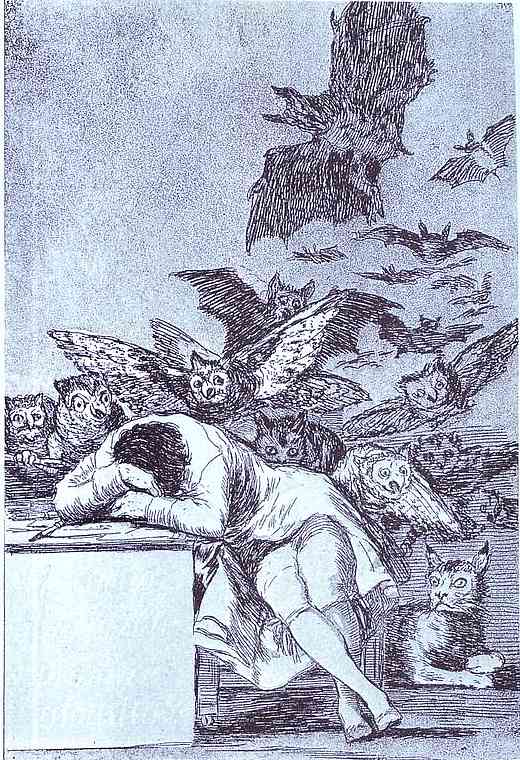
In the mid 18th century, the phenomenon grew in celebrity when Henry Fuseli painted: ‘The Nightmare’ 

and Francisco de Goya, a few years later, etched his famous print-work: ‘The Sleep of Reason Produces Monsters’. 

Both masterpieces were only two, of many, that depicted these mythological imps.
The German’s served as a source to the etymological birth, by adding the word ‘night’ or ‘Nacht’, to stress out the dream aspect of the experience. Hence the word ‘Nachtmahr’ or its cognate in english: “nightmare.”
German Folklorist, Franz Felix Adalbert Kuhn, devised, or recorded, an ancient spell-charm that served to ward off these attacks.

Here I am lying down to sleep;
No night-mare shall plague me
until they have swum through all the waters
that flow upon the earth,
and counted all stars
that appear in the skies.
Thus help me God Father, Son, and Holy Ghost. 
Amen!

Excerpt: The Wraith of The Obelisk- L.J. Gomez.

Unseen Buenos Aires: Urban Legends- Lion Palace-


“It is a common misconception, at least in a great deal of cities, that in the oldest parts of town lay the highest, and deadliest, concentrations of ghosts. It is normally believed that archaic and dilapidated buildings serve as a melting pot for restless spirits. Although that is sometimes the case, and Buenos Aires falls true to that norm; quantity does not usually attest to quality.
If a ghost story, is in part, remembered not for the fact that it exist, but by the apparition and its level of hostility, then there is one particular district we must travel to in the Capital of Argentina.
 Our fascination for the morose, and macabre, makes us openly appreciate poltergeists and demons, far more than we do a friendly spirit like Casper. We like a good ghost story, but relish in a supernatural terror fest. Blood and gore sparkles our imagination and drives us into a devilish glee.
In Buenos Aires, that freak show, those horrible and damnable legends, are in abundance in what many call: ‘the cursed neighborhood of Belgrano.’ 
Situated to the west of the financial, and oldest part of the city, Belgrano is a lovely precinct particularly dedicated to the sole action, that nowadays has been tarnished, of living peacefully; of veering away from the hustle and bustle that go hand in hand with office hours, and serving as a place of rest. A tiny island of bliss, in a thunderstorm of turmoil. An oasis, that with the expansion of Buenos Aires’s wealth, is slowly being taken over.
This charming hamlet, despite its serene atmosphere, has a few skeletons buried under its not-so-sacred ground. 
For believers, and above all paranormal enthusiast, there exist, out of hundreds of legends, two extremely gory stories: the tale of ‘The Lions’s Palace’ and the fable of ‘The Abbey of Saint Benedict.’
First let us start with, what is nowadays referred to as,  the Devil’s house: ‘The Lions’s Palace.’

Erected from ill gotten money, and with the only real purpose to dazzle the rubes and rob them of any suspicion that the were being swindled, “The Lions’s Palace”- it was named in account of a duo of monolithic marble lion statues that guarded its doors- stood for, almost forty years, in the intersection of two mayor avenues in Belgrano: Luis M. Campos and Jose Hernandez.  
The stonework was a castle plucked out of a medieval tapestry. A gothic romantic structure that would have fitted well in some charming valley in Budapest. Standing on a hill, atop a small soil rampart, it featured, besides its two guardians, a large stone parapet erected against a long stone tower. Constructed in 1907, it served as a hideout for an Italian conman known as Ernesto Patrizio di Castiglione. 


Castiglione had a flair for the dramatic and was, in the neighborhood's undertone, associated with the dark arts. ‘The Warlock’, as some knew him, had an ill reputation for demonic rituals and Satanic practices. 
When he fell in love with an innocent girl by the name of Amalita Oromí, he did everything in his power to obtain his hearts attentions; he was even suspected of having drowned the young lady’s other suitor, on the day they would have both participated in a pistol duel for her favors. Unable to fight off his advances, Amalita relented and decided to wed the count on September 28th, 1907. She never reached the altar, but instead died of a strange sickness on the mourning of her weeding day. 
Amalita Oromí was buried in the hallowed grounds of the famous Cemetery of Recoleta. A week after her entombment, a white figure started haunting the gardens of ‘The Lions’s Palace.’ The locals colorfully titled the creature: ‘The White Zombie’. They were certain that the Count had conjured up a deal with the Devil, and revived his beloved bride. 
Soon after, the horror stories began: children and pets started vanishing, chants and ghostly voices road the winds  around the castle, and even the police feared to guard the block after nightfall.
After a series of kidnappings of local boys, who were never heard from again, an effort was made to alleviate the fear and Amalita’s grave was exhumed. The coffin, as it is a routine occurrence in such tales, was empty. Castiglione’s house was finally raided, and the Count himself placed under arrest for desecration and pension fraud. It was discovered that most, if not all, of his fortune was stolen from old retirees.
The Count disappeared on his way to jail that evening. He was placed under custody, handcuffed and loaded into a police wagon, but, when the vehicle arrived at the station, the fiend had faded into nothingness; never to be heard from again.
Years later the house was bought by one of the richest citizens in Argentina: Teofilo Lacroze, son of the rail magnate; Federico Lacroze. 
Teofilo’s family resided for less than a month in the castle, that had cost him a fortune. They left in terrified haste. Every entry, window, hole or gate, was walled-in as soon as they fled; sealing whatever ghoul lay inside into a makeshift coffin for evil. To this day, what the family witness in that place remains a mystery. 
By the 1940’s Teofilo had the castle demolished and the land beneath it razed, and salted. 
Weary travelers, the intersection, that once footed this monster, is still feared by its neighbors... The Count’s ‘White Zombie’ spotted, every so often, under an energy efficient bulb.

Excerpt: The Wraith of The Obelisk- L.J. Gomez.